
Most business owners do not ignore cyber security because they do not care.
They ignore it because it feels like another bill.
Another licence. Another monthly cost. Another technical conversation full of acronyms. So it gets pushed to later — after the next big invoice is paid, after the new staff member starts, after the website is updated, after things quieten down.
The problem is that cyber criminals do not wait until business is quiet.
For Australian small businesses, the average self-reported cost of cybercrime per report in FY2024–25 was around $56,600, and medium businesses reported an average of around $97,200.
That is not just an IT issue. That is cash flow. Payroll. Reputation. Client trust. Downtime. Stress. Lost work. And in some cases, the survival of the business.
The real cost is not just financial
When people talk about cyber attacks, they often talk about money first.
How much was stolen?
How much did recovery cost?
How much was the ransom?
How much did the insurance excess come to?
But the real cost goes further.
A cyber incident can stop staff from working, delay client delivery, damage trust, expose private information, and put business owners under enormous pressure. The Australian Cyber Security Centre warns that even a minor cyber security incident can have devastating impacts for a small business.
That is why cyber security should not be viewed as “buying software”.
It is protecting the business you have spent years building.
“We have antivirus” is not a cyber security strategy
Antivirus is still useful.
But relying on antivirus alone today is like saying:
“My car has a steering lock, so I do not need insurance, central locking, an alarm, a garage, or to check where I park it.”
A steering lock is better than nothing. But it does not stop every thief.
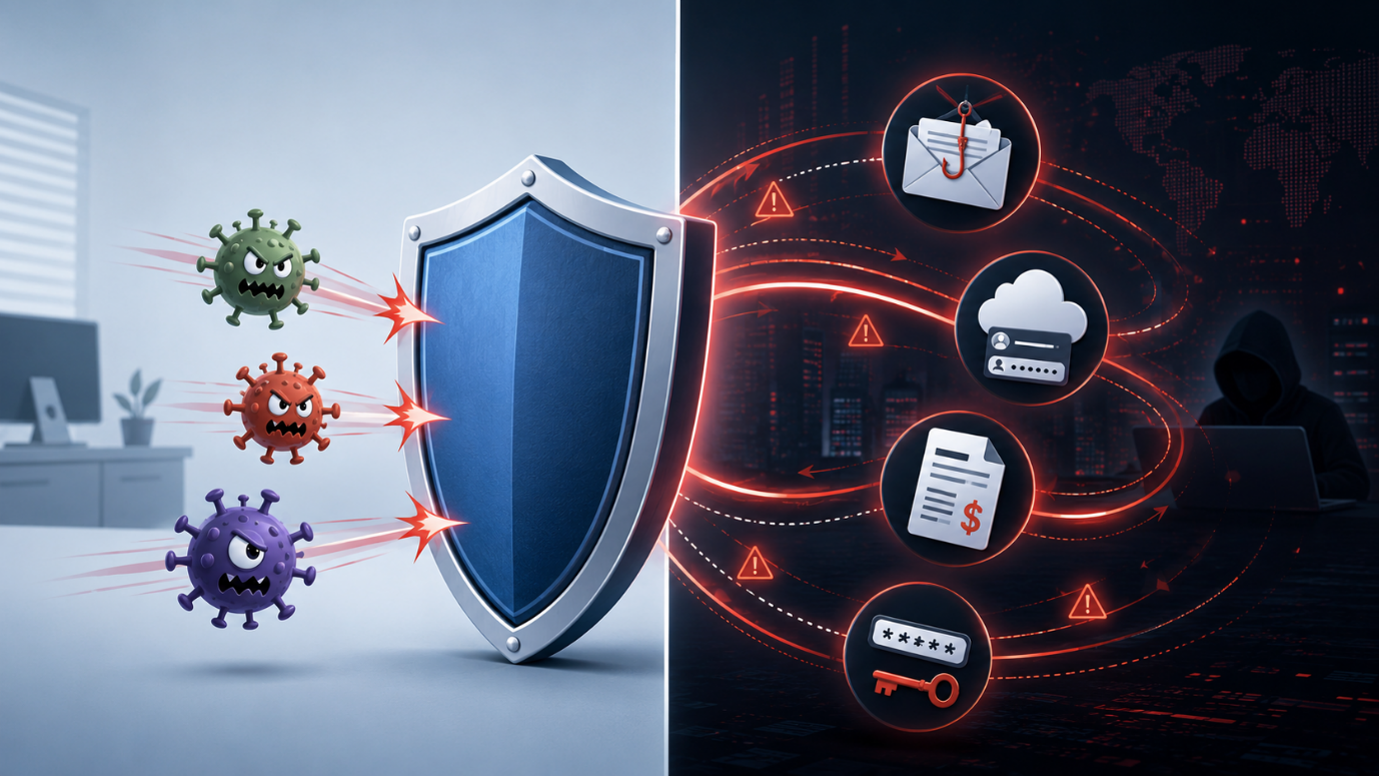
Antivirus works in a similar way. It is one layer. It can help detect known malicious files, but modern attacks often do not look like old-school viruses. They may start with a fake Microsoft 365 login page, a compromised email account, a stolen password, a staff member clicking a link, or someone logging in from overseas using legitimate credentials.
The LinkedIn antivirus-myth post said the same thing in simple terms: antivirus is only one layer, and businesses also need things like monitoring, patching, backups, firewalls, and user awareness.
Small businesses are not “too small” to be targeted
A common belief is:
“We are only a small business. Why would anyone target us?”
The answer is simple: most attacks are not personal.
Cyber criminals often use automation to scan thousands of businesses for weak passwords, exposed systems, missing updates, and poorly protected email accounts. They are not always choosing a business because it is famous. They are choosing the business because the door is open.
SecurityBrief recently made the same point: ransomware, phishing, and business email compromise do not discriminate by company size; attackers look for opportunity, and under-resourced IT environments create that opportunity.
So the question is not, “Are we big enough to be attacked?”
The better question is:
“Are we easy enough to be attacked?”
Why business owners delay security
For many SMBs, cyber security becomes an afterthought because it does not feel urgent until something goes wrong.
It is also hard to value. A business owner can see a new laptop. They can see a new website. They can see a new phone system.
But good cyber security is often invisible.
When it works, nothing happens.
No breach. No downtime. No panic. No urgent weekend recovery. No awkward client email explaining that sensitive information may have been exposed.
That invisibility makes it easy to mistake security for an expense instead of seeing it as protection.
Research from Mastercard found that cost was the primary barrier stopping Australian small businesses from exploring cyber security options, followed by time and lack of knowledge about available solutions.
That is exactly why security needs to be explained in business terms, not technical ones.
The coffee test
One of the simplest ways to think about basic cyber protection is this:
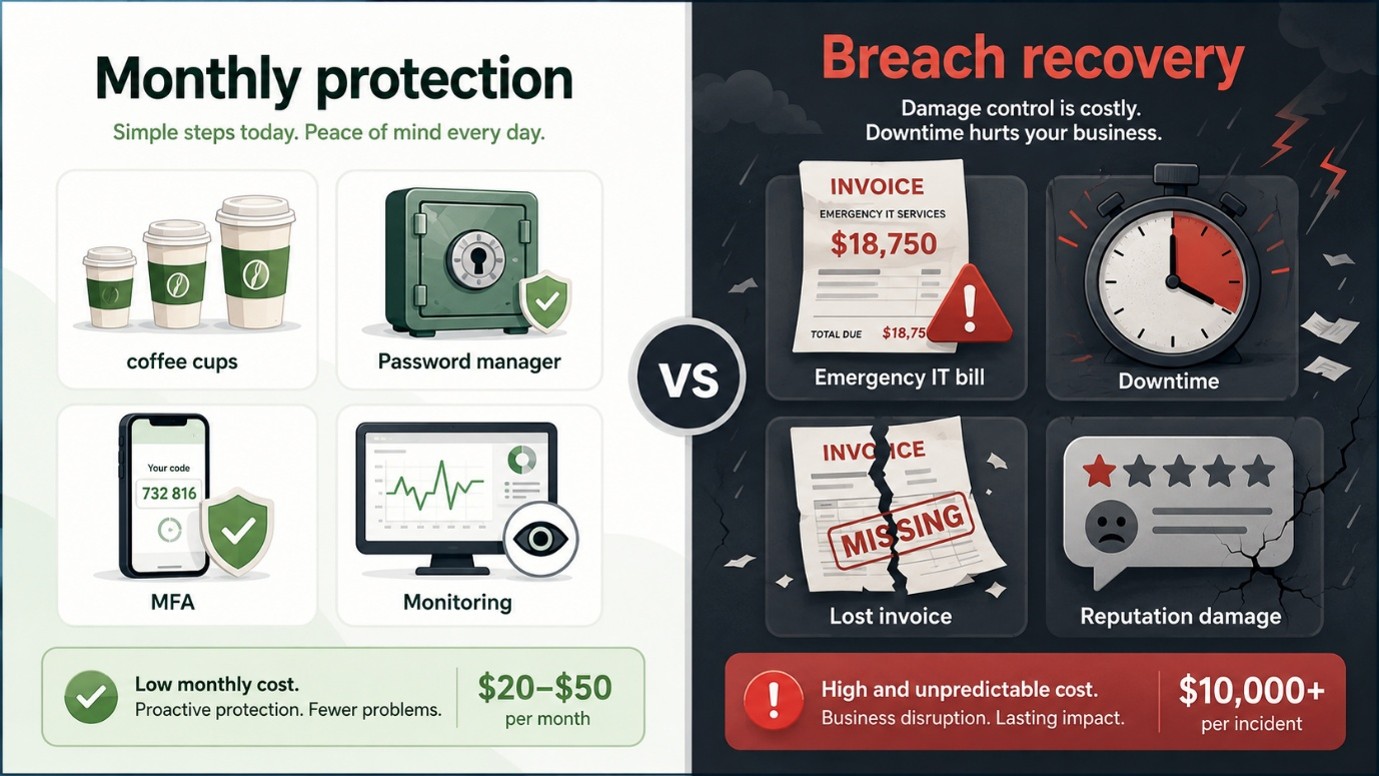
If protecting a user costs roughly the same as a few coffees a week, but a cyber incident can cost tens of thousands of dollars, is the monthly security cost really the expensive option?
Netlogyx made a similar comparison in its password manager article, noting that a business password manager can cost less than a dozen coffees per month while removing one of the most commonly exploited weaknesses: poor password practices.
That does not mean every business needs every security product.
It means the conversation should change from:
“How much does this cost?”
to:
“What risk does this reduce, and what would it cost us if we did nothing?”
What good security looks like for a small business
Good cyber security does not need to be confusing.
For most SMBs, the starting point is practical and sensible:
Multi-factor authentication
This is the extra code or approval prompt when someone logs in. It helps stop attackers even if they steal a password.
Software updates
Updates fix known weaknesses. Delaying them gives attackers more time to use those weaknesses.
Backups
If files are deleted, encrypted, or corrupted, backups can help the business recover.
Password management
Staff should not reuse passwords or share them through email, chat, spreadsheets, or sticky notes.
Endpoint protection and monitoring
Laptops and desktops need protection, but they also need visibility. Someone needs to know when something suspicious is happening.
Email security and user awareness
Many attacks begin with email. Staff need simple training, and email systems need strong filtering.
The ACSC recommends three key starting measures for small businesses: turn on multi-factor authentication, update software, and back up information.
Why MDR is different from antivirus
Traditional antivirus asks:
“Is this file known to be bad?”
Managed Detection and Response, or MDR, asks a broader question:
“Is something unusual happening in the business?”
That might include a login from an unexpected country, a user accessing files they normally never touch, a device behaving strangely, or an attacker using legitimate tools to move quietly through the environment.
Netlogyx described MDR as combining technology with human expertise to monitor, detect, investigate, and respond to threats, rather than simply blocking known malware. That human element matters.
Most small businesses do not have someone watching security alerts at 11:30pm on a Saturday. MDR helps fill that gap.
Cyber security is not about fear. It is about continuity.
The point of cyber security is not to scare business owners.
- It is to keep the business operating.
- It is about making sure staff can work tomorrow.
- Invoices can still be paid.
- Clients can still be served.
- Private information stays private.
- The business owner is not forced into crisis mode because one password was reused or one email was clicked.
A strong cyber security plan does not need to be perfect on day one. But it does need to start. Because the most expensive security decision is usually not the one you approve. It is the one you delay until after the incident.
Final call to action
Not sure where your business stands?
Managed Services Australia can review your current setup and give you a clear, practical view of what is working, what is missing, and what should be prioritised first.
No scare tactics; No unnecessary complexity; Just a sensible cyber security plan built around your business risk.
Book a Cyber Security & Technology Audit today.
🌐 Explore our services at Managed Services Australia.
📧 Dial 1300 024 748, shoot us an email at [email protected], or schedule a session with one of our IT specialists.