
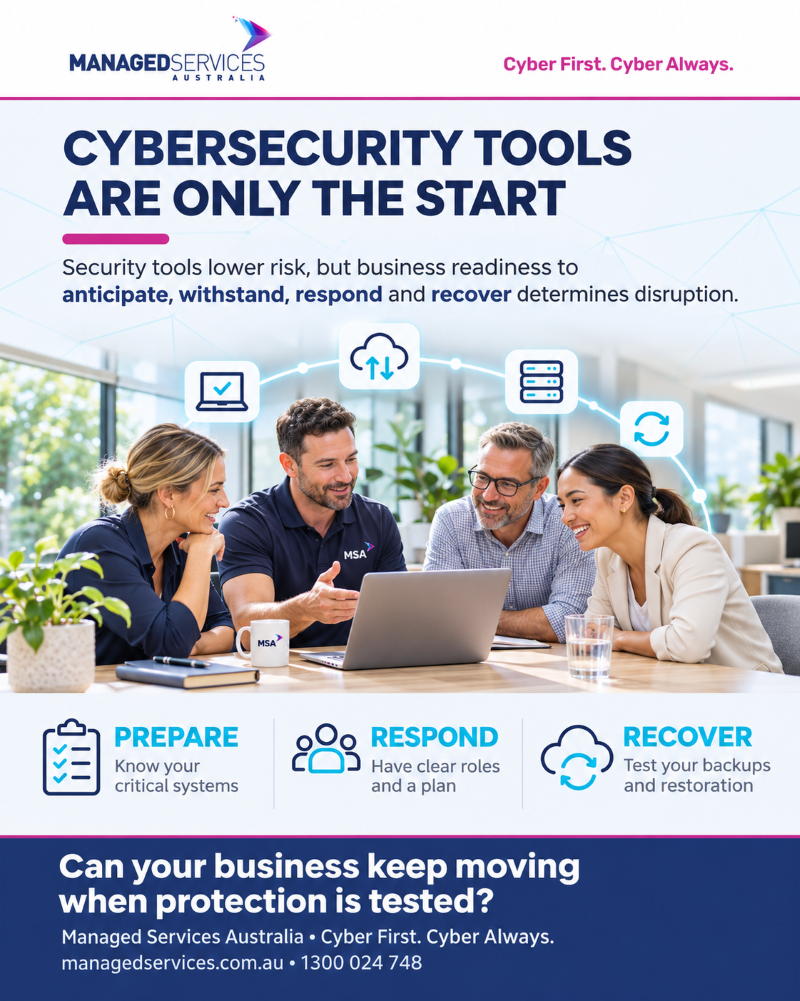
Cybersecurity tools can help prevent attacks. But when something goes wrong, it’s your business’s ability to respond and recover that determines the damage.
Imagine arriving at work on a Monday morning to discover that your business systems are inaccessible. Employees cannot open critical files, customers are calling because services are unavailable, and an unfamiliar message appears on your server demanding payment to restore access.
Your IT provider is investigating. Your staff are waiting for instructions. Management wants to know how long operations will be disrupted, whether customer information has been compromised, and what the incident will cost.
The problem is that nobody has a clear answer.
This is the reality businesses risk facing when they invest in cybersecurity technology without giving equal attention to cyber resilience.
Firewalls, endpoint protection, email security and multifactor authentication are essential components of a strong security environment. However, having these technologies in place does not guarantee that a business can withstand an attack or recover quickly.
The question is no longer simply whether your business has cybersecurity protection. It is whether your business is prepared for the moment that protection is tested.
The Financial Reality of Cyber Incidents in Australia
Cybercrime is not a problem reserved for multinational corporations. Australian small and medium-sized businesses are regularly targeted because they rely on technology, process financial transactions and hold information that criminals can exploit.
According to the Australian Signals Directorate’s Annual Cyber Threat Report 2024–25, the average self-reported cost of cybercrime increased by 50% across Australian businesses, reaching approximately $80,850 per report.
For small businesses, the average was approximately $56,600, while medium-sized businesses reported an average of approximately $97,200.
These figures represent a significant financial exposure, particularly for businesses operating with limited cash reserves or relying heavily on continuous access to their systems.
But the financial impact of a cyberattack often extends beyond the immediate loss.
Consider the consequences of several days of operational disruption. Employees may be unable to perform their duties, customer appointments may need to be cancelled, suppliers may experience payment delays, and management may spend valuable time coordinating recovery rather than running the business.
There may also be investigation expenses, legal obligations, reputational damage and the cost of restoring affected systems.
For some businesses, the most significant consequence is not the attack itself. It is the interruption to normal operations and the uncertainty surrounding recovery.
Cybersecurity and Cyber Resilience Are Not the Same Thing
Cybersecurity and cyber resilience are closely connected, but they address different aspects of business risk.
Cybersecurity focuses on protecting systems, networks, accounts and information from unauthorised access, malicious activity and other threats.
Cyber resilience takes a broader view. It considers whether an organisation can anticipate, withstand, respond to and recover from a cyber incident while maintaining or restoring essential business operations.
A business may have advanced endpoint protection, managed detection and response, secure email filtering and a properly configured firewall. These controls reduce the likelihood and potential impact of an attack.
However, important questions remain.
If a critical server becomes unavailable, how quickly can operations be restored? If an employee’s account is compromised, who has the authority to disable access? If sensitive customer information is exposed, who determines the reporting obligations? If the incident occurs outside business hours, who coordinates the response?
The answers to these questions are not found in a firewall configuration or antivirus dashboard.
They require planning, governance, clearly defined responsibilities and tested recovery procedures.
Strong cybersecurity reduces the probability of an incident. Strong cyber resilience reduces the disruption when an incident occurs.
A mature security strategy needs both.
Having Backups Does Not Automatically Mean You Can Recover
One of the most common assumptions businesses make is that their data is safe because backups are running.
Backups are essential, particularly when responding to ransomware, accidental deletion, hardware failure or system corruption. However, the existence of a backup does not automatically guarantee successful or timely recovery.
A business might discover that its backups are incomplete, that critical applications were never included, or that the recovery process takes considerably longer than expected.
In more serious cases, attackers may deliberately attempt to compromise or delete accessible backup systems before launching a ransomware attack.
This is why a resilient backup strategy must consider more than backup frequency.
Businesses should understand which systems are protected, where backup copies are stored, whether those copies are adequately isolated from production systems and how restoration is performed.
Equally important is establishing realistic recovery objectives.
A Recovery Time Objective (RTO) defines how quickly a system needs to be restored following a disruption. A Recovery Point Objective (RPO) identifies how much data loss, measured in time, the business can tolerate.
For example, a business might determine that its accounting system must be restored within four hours and that losing more than one hour of transactions would be unacceptable.
Those requirements should influence how backup and recovery systems are designed.
Regular restoration testing is essential because a successful backup notification confirms that a backup job completed, not necessarily that the business can restore its operations within the required timeframe.
The First Hour of a Cyber Incident Matters
When a cyber incident occurs, speed and coordination can significantly influence the outcome.
Imagine an attacker gains access to an employee’s Microsoft 365 account. The attacker may attempt to create malicious inbox rules, access confidential emails, establish persistence or impersonate the employee in communications with customers and suppliers.
Without effective monitoring, suspicious activity may continue undetected.
Even when an alert is generated, the organisation needs a process for determining whether the activity is malicious and deciding what action to take.
This is where security monitoring, managed detection and response (MDR), and incident response procedures become critical.
An effective response may involve investigating unusual sign-ins, reviewing authentication activity, revoking compromised sessions, isolating affected endpoints and assessing whether additional accounts or systems are involved.
However, technical actions are only one part of the response.
The organisation must also determine who needs to be informed, whether business operations are affected, whether external assistance is required and how the incident should be documented.
Without a documented incident response plan, valuable time can be lost while individuals attempt to determine responsibilities during an already stressful situation.
A well-prepared business should not be designing its incident response process while an attacker is actively operating inside its environment.
Five Questions Every Business Leader Should Be Able to Answer
Cyber resilience does not require every business owner to become a cybersecurity expert. It does require business leaders to understand their organisation’s exposure and the arrangements in place to manage it.
Start by asking five questions.
- Would we know if someone compromised our systems?
Protective controls are important, but businesses also need visibility into suspicious activity across identities, endpoints, networks and cloud services. Monitoring and alert investigation help identify threats that preventive controls may not stop.
- Who takes responsibility when a cyber incident occurs?
The incident response process should identify technical responders, business decision-makers, escalation contacts and communication responsibilities. This includes arrangements for incidents occurring outside standard operating hours.
- How quickly could we restore our most critical systems?
Recovery expectations should be based on business requirements and supported by tested restoration procedures, not assumptions about what a backup product can deliver.
- What would happen if our business could not operate for two days?
Understanding the operational and financial consequences of disruption helps identify which systems and business processes deserve the highest recovery priority.
- When did we last test our cyber incident response plan?
A documented plan is valuable, but its effectiveness should be validated. Tabletop exercises, recovery tests and incident simulations can uncover weaknesses before a real attack occurs.
If these questions cannot be answered confidently, the organisation may have important gaps in its cyber resilience strategy.
Cyber Resilience Requires More Than Technology
Building cyber resilience is not about purchasing every available security product.
It is about ensuring that people, processes and technology work together to protect business operations.
Technical controls such as endpoint detection and response, email security, identity protection, firewalls and security monitoring help reduce exposure and identify suspicious behaviour.
Governance provides the structure for understanding risks, defining accountability, prioritising improvements and making informed decisions.
Incident response planning establishes how the organisation will investigate and contain threats, communicate effectively and coordinate recovery.
Business continuity and disaster recovery planning address how essential services can be maintained or restored when systems become unavailable.
These elements should not operate independently.
For example, an organisation’s recovery requirements should influence backup design. Its risk assessment should inform monitoring priorities. Its incident response procedures should align with its internal responsibilities and external service providers.
The Australian Cyber Security Centre recommends that organisations develop, maintain and test incident response plans appropriate to their operating environments.
The objective is not to eliminate every possible risk. That is neither realistic nor achievable.
Instead, businesses should build a security environment in which risks are understood, threats are detected, incidents are managed and essential operations can recover with minimal practical disruption.
From Cybersecurity Protection to Business Confidence
Cybersecurity investment should ultimately support business continuity, customer trust and operational confidence.
A business that understands its critical systems, maintains effective security controls, monitors for suspicious activity and regularly tests its response capabilities is better positioned to manage unexpected incidents.
This also changes how cybersecurity is discussed at a leadership level.
Instead of focusing exclusively on the number of threats blocked or security products deployed, management can evaluate questions that directly affect the organisation.
How exposed are our critical business systems? How quickly are threats investigated? How prepared are we to respond? How much disruption can we tolerate? Are our recovery arrangements actually working?
These are business risk questions, not simply technical questions.
And answering them requires an approach that combines security operations, strategic oversight and continuous improvement.
Is Your Business Prepared for What Comes Next?
No security solution can guarantee that a business will never experience a cyber incident.
What businesses can control is how prepared they are to recognise a threat, respond effectively and recover from disruption.
At Managed Services Australia (MSA), we help organisations strengthen their cybersecurity posture through layered security controls, proactive monitoring, incident response capabilities and strategic cybersecurity guidance.
Our approach focuses on aligning cybersecurity measures with business risks, helping organisations move beyond simply deploying security tools towards building a more resilient operating environment.
Because when a cyber incident occurs, having security technology in place is only part of the equation.
What matters is whether your business can respond, recover and keep moving forward.
🌐 Explore our services at Managed Services Australia.
📧 Dial 1300 024 748, shoot us an email at [email protected], or schedule a session with one of our IT specialists.